# yaml-language-server: $schema=https://schema.zeabur.app/template.json
apiVersion: zeabur.com/v1
kind: Template
metadata:
name: Umami
spec:
description: Umami makes it easy to collect, analyze, and understand your web data
coverImage: https://umami.is/images/app.jpg
icon: https://avatars.githubusercontent.com/u/105618662?s=48&v=4
tags:
- Tool
- Website
- Monitoring
readme: |-
## Description
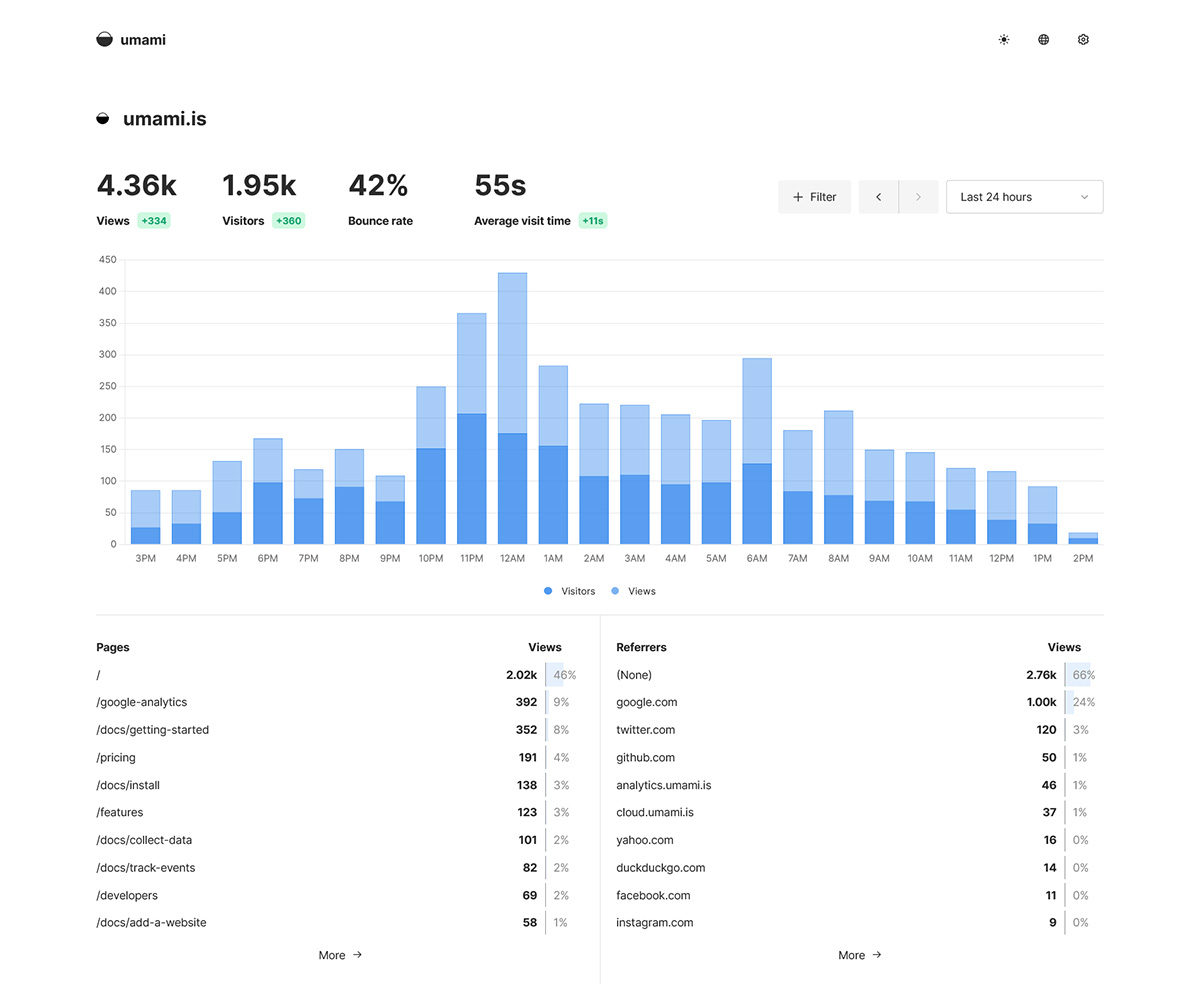
Umami makes it easy to collect, analyze, and understand your web data — while maintaining visitor privacy and data ownership.
services:
- name: Umami
icon: https://raw.githubusercontent.com/zeabur/service-icons/main/marketplace/umami.svg
template: PREBUILT
spec:
source:
image: ghcr.io/umami-software/umami:postgresql-latest
ports:
- id: web
port: 3000
type: HTTP
env:
DATABASE_TYPE:
default: postgresql
DATABASE_URL:
default: ${POSTGRES_CONNECTION_STRING}
HASH_SALT:
default: ${PASSWORD}
- name: PostgreSQL
icon: https://raw.githubusercontent.com/zeabur/service-icons/main/marketplace/postgresql.svg
template: PREBUILT
spec:
source:
image: postgres:16
command:
- docker-entrypoint.sh
- -c
- config_file=/etc/postgresql/postgresql.conf
ports:
- id: database
port: 5432
type: TCP
volumes:
- id: data
dir: /var/lib/postgresql/data
instructions:
- title: Connection String
content: postgresql://${POSTGRES_USERNAME}:${POSTGRES_PASSWORD}@${PORT_FORWARDED_HOSTNAME}:${DATABASE_PORT_FORWARDED_PORT}/${POSTGRES_DATABASE}
- title: PostgreSQL Connect Command
content: psql "postgresql://${POSTGRES_USERNAME}:${POSTGRES_PASSWORD}@${PORT_FORWARDED_HOSTNAME}:${DATABASE_PORT_FORWARDED_PORT}/${POSTGRES_DATABASE}"
- title: PostgreSQL username
content: ${POSTGRES_USERNAME}
- title: PostgresSQL password
content: ${POSTGRES_PASSWORD}
- title: PostgresSQL database
content: ${POSTGRES_DATABASE}
- title: PostgreSQL host
content: ${PORT_FORWARDED_HOSTNAME}
- title: PostgreSQL port
content: ${DATABASE_PORT_FORWARDED_PORT}
env:
PGDATA:
default: /var/lib/postgresql/data/pgdata
POSTGRES_CONNECTION_STRING:
default: postgresql://${POSTGRES_USERNAME}:${POSTGRES_PASSWORD}@${POSTGRES_HOST}:${POSTGRES_PORT}/${POSTGRES_DATABASE}
expose: true
POSTGRES_DATABASE:
default: ${POSTGRES_DB}
expose: true
POSTGRES_DB:
default: zeabur
POSTGRES_HOST:
default: ${CONTAINER_HOSTNAME}
expose: true
POSTGRES_PASSWORD:
default: ${PASSWORD}
expose: true
POSTGRES_PORT:
default: ${DATABASE_PORT}
expose: true
POSTGRES_URI:
default: ${POSTGRES_CONNECTION_STRING}
expose: true
POSTGRES_USER:
default: root
POSTGRES_USERNAME:
default: ${POSTGRES_USER}
expose: true
configs:
- path: /etc/postgresql/postgresql.conf
template: |
# -----------------------------
# PostgreSQL configuration file
# -----------------------------
#
# This file consists of lines of the form:
#
# name = value
#
# (The "=" is optional.) Whitespace may be used. Comments are introduced with
# "#" anywhere on a line. The complete list of parameter names and allowed
# values can be found in the PostgreSQL documentation.
#
# The commented-out settings shown in this file represent the default values.
# Re-commenting a setting is NOT sufficient to revert it to the default value;
# you need to reload the server.
#
# This file is read on server startup and when the server receives a SIGHUP
# signal. If you edit the file on a running system, you have to SIGHUP the
# server for the changes to take effect, run "pg_ctl reload", or execute
# "SELECT pg_reload_conf()". Some parameters, which are marked below,
# require a server shutdown and restart to take effect.
#
# Any parameter can also be given as a command-line option to the server, e.g.,
# "postgres -c log_connections=on". Some parameters can be changed at run time
# with the "SET" SQL command.
#
# Memory units: B = bytes Time units: us = microseconds
# kB = kilobytes ms = milliseconds
# MB = megabytes s = seconds
# GB = gigabytes min = minutes
# TB = terabytes h = hours
# d = days
#------------------------------------------------------------------------------
# FILE LOCATIONS
#------------------------------------------------------------------------------
# The default values of these variables are driven from the -D command-line
# option or PGDATA environment variable, represented here as ConfigDir.
#data_directory = 'ConfigDir' # use data in another directory
# (change requires restart)
#hba_file = 'ConfigDir/pg_hba.conf' # host-based authentication file
# (change requires restart)
#ident_file = 'ConfigDir/pg_ident.conf' # ident configuration file
# (change requires restart)
# If external_pid_file is not explicitly set, no extra PID file is written.
#external_pid_file = '' # write an extra PID file
# (change requires restart)
#------------------------------------------------------------------------------
# CONNECTIONS AND AUTHENTICATION
#------------------------------------------------------------------------------
# - Connection Settings -
listen_addresses = '*'
# comma-separated list of addresses;
# defaults to 'localhost'; use '*' for all
# (change requires restart)
#port = 5432 # (change requires restart)
max_connections = 100 # (change requires restart)
#reserved_connections = 0 # (change requires restart)
#superuser_reserved_connections = 3 # (change requires restart)
#unix_socket_directories = '/var/run/postgresql' # comma-separated list of directories
# (change requires restart)
#unix_socket_group = '' # (change requires restart)
#unix_socket_permissions = 0777 # begin with 0 to use octal notation
# (change requires restart)
#bonjour = off # advertise server via Bonjour
# (change requires restart)
#bonjour_name = '' # defaults to the computer name
# (change requires restart)
# - TCP settings -
# see "man tcp" for details
#tcp_keepalives_idle = 0 # TCP_KEEPIDLE, in seconds;
# 0 selects the system default
#tcp_keepalives_interval = 0 # TCP_KEEPINTVL, in seconds;
# 0 selects the system default
#tcp_keepalives_count = 0 # TCP_KEEPCNT;
# 0 selects the system default
#tcp_user_timeout = 0 # TCP_USER_TIMEOUT, in milliseconds;
# 0 selects the system default
#client_connection_check_interval = 0 # time between checks for client
# disconnection while running queries;
# 0 for never
# - Authentication -
#authentication_timeout = 1min # 1s-600s
#password_encryption = scram-sha-256 # scram-sha-256 or md5
#scram_iterations = 4096
#db_user_namespace = off
# GSSAPI using Kerberos
#krb_server_keyfile = 'FILE:${sysconfdir}/krb5.keytab'
#krb_caseins_users = off
#gss_accept_delegation = off
# - SSL -
#ssl = off
#ssl_ca_file = ''
#ssl_cert_file = 'server.crt'
#ssl_crl_file = ''
#ssl_crl_dir = ''
#ssl_key_file = 'server.key'
#ssl_ciphers = 'HIGH:MEDIUM:+3DES:!aNULL' # allowed SSL ciphers
#ssl_prefer_server_ciphers = on
#ssl_ecdh_curve = 'prime256v1'
#ssl_min_protocol_version = 'TLSv1.2'
#ssl_max_protocol_version = ''
#ssl_dh_params_file = ''
#ssl_passphrase_command = ''
#ssl_passphrase_command_supports_reload = off
#------------------------------------------------------------------------------
# RESOURCE USAGE (except WAL)
#------------------------------------------------------------------------------
# - Memory -
shared_buffers = 128MB # min 128kB
# (change requires restart)
#huge_pages = try # on, off, or try
# (change requires restart)
#huge_page_size = 0 # zero for system default
# (change requires restart)
#temp_buffers = 8MB # min 800kB
#max_prepared_transactions = 0 # zero disables the feature
# (change requires restart)
# Caution: it is not advisable to set max_prepared_transactions nonzero unless
# you actively intend to use prepared transactions.
#work_mem = 4MB # min 64kB
#hash_mem_multiplier = 2.0 # 1-1000.0 multiplier on hash table work_mem
#maintenance_work_mem = 64MB # min 1MB
#autovacuum_work_mem = -1 # min 1MB, or -1 to use maintenance_work_mem
#logical_decoding_work_mem = 64MB # min 64kB
#max_stack_depth = 2MB # min 100kB
#shared_memory_type = mmap # the default is the first option
# supported by the operating system:
# mmap
# sysv
# windows
# (change requires restart)
dynamic_shared_memory_type = posix # the default is usually the first option
# supported by the operating system:
# posix
# sysv
# windows
# mmap
# (change requires restart)
#min_dynamic_shared_memory = 0MB # (change requires restart)
#vacuum_buffer_usage_limit = 256kB # size of vacuum and analyze buffer access strategy ring;
# 0 to disable vacuum buffer access strategy;
# range 128kB to 16GB
# - Disk -
#temp_file_limit = -1 # limits per-process temp file space
# in kilobytes, or -1 for no limit
# - Kernel Resources -
#max_files_per_process = 1000 # min 64
# (change requires restart)
# - Cost-Based Vacuum Delay -
#vacuum_cost_delay = 0 # 0-100 milliseconds (0 disables)
#vacuum_cost_page_hit = 1 # 0-10000 credits
#vacuum_cost_page_miss = 2 # 0-10000 credits
#vacuum_cost_page_dirty = 20 # 0-10000 credits
#vacuum_cost_limit = 200 # 1-10000 credits
# - Background Writer -
#bgwriter_delay = 200ms # 10-10000ms between rounds
#bgwriter_lru_maxpages = 100 # max buffers written/round, 0 disables
#bgwriter_lru_multiplier = 2.0 # 0-10.0 multiplier on buffers scanned/round
#bgwriter_flush_after = 512kB # measured in pages, 0 disables
# - Asynchronous Behavior -
#backend_flush_after = 0 # measured in pages, 0 disables
#effective_io_concurrency = 1 # 1-1000; 0 disables prefetching
#maintenance_io_concurrency = 10 # 1-1000; 0 disables prefetching
#max_worker_processes = 8 # (change requires restart)
#max_parallel_workers_per_gather = 2 # taken from max_parallel_workers
#max_parallel_maintenance_workers = 2 # taken from max_parallel_workers
#max_parallel_workers = 8 # maximum number of max_worker_processes that
# can be used in parallel operations
#parallel_leader_participation = on
#old_snapshot_threshold = -1 # 1min-60d; -1 disables; 0 is immediate
# (change requires restart)
#------------------------------------------------------------------------------
# WRITE-AHEAD LOG
#------------------------------------------------------------------------------
# - Settings -
#wal_level = replica # minimal, replica, or logical
# (change requires restart)
#fsync = on # flush data to disk for crash safety
# (turning this off can cause
# unrecoverable data corruption)
#synchronous_commit = on # synchronization level;
# off, local, remote_write, remote_apply, or on
#wal_sync_method = fsync # the default is the first option
# supported by the operating system:
# open_datasync
# fdatasync (default on Linux and FreeBSD)
# fsync
# fsync_writethrough
# open_sync
#full_page_writes = on # recover from partial page writes
#wal_log_hints = off # also do full page writes of non-critical updates
# (change requires restart)
#wal_compression = off # enables compression of full-page writes;
# off, pglz, lz4, zstd, or on
#wal_init_zero = on # zero-fill new WAL files
#wal_recycle = on # recycle WAL files
#wal_buffers = -1 # min 32kB, -1 sets based on shared_buffers
# (change requires restart)
#wal_writer_delay = 200ms # 1-10000 milliseconds
#wal_writer_flush_after = 1MB # measured in pages, 0 disables
#wal_skip_threshold = 2MB
#commit_delay = 0 # range 0-100000, in microseconds
#commit_siblings = 5 # range 1-1000
# - Checkpoints -
#checkpoint_timeout = 5min # range 30s-1d
#checkpoint_completion_target = 0.9 # checkpoint target duration, 0.0 - 1.0
#checkpoint_flush_after = 256kB # measured in pages, 0 disables
#checkpoint_warning = 30s # 0 disables
max_wal_size = 1GB
min_wal_size = 80MB
# - Prefetching during recovery -
#recovery_prefetch = try # prefetch pages referenced in the WAL?
#wal_decode_buffer_size = 512kB # lookahead window used for prefetching
# (change requires restart)
# - Archiving -
#archive_mode = off # enables archiving; off, on, or always
# (change requires restart)
#archive_library = '' # library to use to archive a WAL file
# (empty string indicates archive_command should
# be used)
#archive_command = '' # command to use to archive a WAL file
# placeholders: %p = path of file to archive
# %f = file name only
# e.g. 'test ! -f /mnt/server/archivedir/%f && cp %p /mnt/server/archivedir/%f'
#archive_timeout = 0 # force a WAL file switch after this
# number of seconds; 0 disables
# - Archive Recovery -
# These are only used in recovery mode.
#restore_command = '' # command to use to restore an archived WAL file
# placeholders: %p = path of file to restore
# %f = file name only
# e.g. 'cp /mnt/server/archivedir/%f %p'
#archive_cleanup_command = '' # command to execute at every restartpoint
#recovery_end_command = '' # command to execute at completion of recovery
# - Recovery Target -
# Set these only when performing a targeted recovery.
#recovery_target = '' # 'immediate' to end recovery as soon as a
# consistent state is reached
# (change requires restart)
#recovery_target_name = '' # the named restore point to which recovery will proceed
# (change requires restart)
#recovery_target_time = '' # the time stamp up to which recovery will proceed
# (change requires restart)
#recovery_target_xid = '' # the transaction ID up to which recovery will proceed
# (change requires restart)
#recovery_target_lsn = '' # the WAL LSN up to which recovery will proceed
# (change requires restart)
#recovery_target_inclusive = on # Specifies whether to stop:
# just after the specified recovery target (on)
# just before the recovery target (off)
# (change requires restart)
#recovery_target_timeline = 'latest' # 'current', 'latest', or timeline ID
# (change requires restart)
#recovery_target_action = 'pause' # 'pause', 'promote', 'shutdown'
# (change requires restart)
#------------------------------------------------------------------------------
# REPLICATION
#------------------------------------------------------------------------------
# - Sending Servers -
# Set these on the primary and on any standby that will send replication data.
#max_wal_senders = 10 # max number of walsender processes
# (change requires restart)
#max_replication_slots = 10 # max number of replication slots
# (change requires restart)
#wal_keep_size = 0 # in megabytes; 0 disables
#max_slot_wal_keep_size = -1 # in megabytes; -1 disables
#wal_sender_timeout = 60s # in milliseconds; 0 disables
#track_commit_timestamp = off # collect timestamp of transaction commit
# (change requires restart)
# - Primary Server -
# These settings are ignored on a standby server.
#synchronous_standby_names = '' # standby servers that provide sync rep
# method to choose sync standbys, number of sync standbys,
# and comma-separated list of application_name
# from standby(s); '*' = all
# - Standby Servers -
# These settings are ignored on a primary server.
#primary_conninfo = '' # connection string to sending server
#primary_slot_name = '' # replication slot on sending server
#hot_standby = on # "off" disallows queries during recovery
# (change requires restart)
#max_standby_archive_delay = 30s # max delay before canceling queries
# when reading WAL from archive;
# -1 allows indefinite delay
#max_standby_streaming_delay = 30s # max delay before canceling queries
# when reading streaming WAL;
# -1 allows indefinite delay
#wal_receiver_create_temp_slot = off # create temp slot if primary_slot_name
# is not set
#wal_receiver_status_interval = 10s # send replies at least this often
# 0 disables
#hot_standby_feedback = off # send info from standby to prevent
# query conflicts
#wal_receiver_timeout = 60s # time that receiver waits for
# communication from primary
# in milliseconds; 0 disables
#wal_retrieve_retry_interval = 5s # time to wait before retrying to
# retrieve WAL after a failed attempt
#recovery_min_apply_delay = 0 # minimum delay for applying changes during recovery
# - Subscribers -
# These settings are ignored on a publisher.
#max_logical_replication_workers = 4 # taken from max_worker_processes
# (change requires restart)
#max_sync_workers_per_subscription = 2 # taken from max_logical_replication_workers
#max_parallel_apply_workers_per_subscription = 2 # taken from max_logical_replication_workers
#------------------------------------------------------------------------------
# QUERY TUNING
#------------------------------------------------------------------------------
# - Planner Method Configuration -
#enable_async_append = on
#enable_bitmapscan = on
#enable_gathermerge = on
#enable_hashagg = on
#enable_hashjoin = on
#enable_incremental_sort = on
#enable_indexscan = on
#enable_indexonlyscan = on
#enable_material = on
#enable_memoize = on
#enable_mergejoin = on
#enable_nestloop = on
#enable_parallel_append = on
#enable_parallel_hash = on
#enable_partition_pruning = on
#enable_partitionwise_join = off
#enable_partitionwise_aggregate = off
#enable_presorted_aggregate = on
#enable_seqscan = on
#enable_sort = on
#enable_tidscan = on
# - Planner Cost Constants -
#seq_page_cost = 1.0 # measured on an arbitrary scale
#random_page_cost = 4.0 # same scale as above
#cpu_tuple_cost = 0.01 # same scale as above
#cpu_index_tuple_cost = 0.005 # same scale as above
#cpu_operator_cost = 0.0025 # same scale as above
#parallel_setup_cost = 1000.0 # same scale as above
#parallel_tuple_cost = 0.1 # same scale as above
#min_parallel_table_scan_size = 8MB
#min_parallel_index_scan_size = 512kB
#effective_cache_size = 4GB
#jit_above_cost = 100000 # perform JIT compilation if available
# and query more expensive than this;
# -1 disables
#jit_inline_above_cost = 500000 # inline small functions if query is
# more expensive than this; -1 disables
#jit_optimize_above_cost = 500000 # use expensive JIT optimizations if
# query is more expensive than this;
# -1 disables
# - Genetic Query Optimizer -
#geqo = on
#geqo_threshold = 12
#geqo_effort = 5 # range 1-10
#geqo_pool_size = 0 # selects default based on effort
#geqo_generations = 0 # selects default based on effort
#geqo_selection_bias = 2.0 # range 1.5-2.0
#geqo_seed = 0.0 # range 0.0-1.0
# - Other Planner Options -
#default_statistics_target = 100 # range 1-10000
#constraint_exclusion = partition # on, off, or partition
#cursor_tuple_fraction = 0.1 # range 0.0-1.0
#from_collapse_limit = 8
#jit = on # allow JIT compilation
#join_collapse_limit = 8 # 1 disables collapsing of explicit
# JOIN clauses
#plan_cache_mode = auto # auto, force_generic_plan or
# force_custom_plan
#recursive_worktable_factor = 10.0 # range 0.001-1000000
#------------------------------------------------------------------------------
# REPORTING AND LOGGING
#------------------------------------------------------------------------------
# - Where to Log -
#log_destination = 'stderr' # Valid values are combinations of
# stderr, csvlog, jsonlog, syslog, and
# eventlog, depending on platform.
# csvlog and jsonlog require
# logging_collector to be on.
# This is used when logging to stderr:
#logging_collector = off # Enable capturing of stderr, jsonlog,
# and csvlog into log files. Required
# to be on for csvlogs and jsonlogs.
# (change requires restart)
# These are only used if logging_collector is on:
#log_directory = 'log' # directory where log files are written,
# can be absolute or relative to PGDATA
#log_filename = 'postgresql-%Y-%m-%d_%H%M%S.log' # log file name pattern,
# can include strftime() escapes
#log_file_mode = 0600 # creation mode for log files,
# begin with 0 to use octal notation
#log_rotation_age = 1d # Automatic rotation of logfiles will
# happen after that time. 0 disables.
#log_rotation_size = 10MB # Automatic rotation of logfiles will
# happen after that much log output.
# 0 disables.
#log_truncate_on_rotation = off # If on, an existing log file with the
# same name as the new log file will be
# truncated rather than appended to.
# But such truncation only occurs on
# time-driven rotation, not on restarts
# or size-driven rotation. Default is
# off, meaning append to existing files
# in all cases.
# These are relevant when logging to syslog:
#syslog_facility = 'LOCAL0'
#syslog_ident = 'postgres'
#syslog_sequence_numbers = on
#syslog_split_messages = on
# This is only relevant when logging to eventlog (Windows):
# (change requires restart)
#event_source = 'PostgreSQL'
# - When to Log -
#log_min_messages = warning # values in order of decreasing detail:
# debug5
# debug4
# debug3
# debug2
# debug1
# info
# notice
# warning
# error
# log
# fatal
# panic
#log_min_error_statement = error # values in order of decreasing detail:
# debug5
# debug4
# debug3
# debug2
# debug1
# info
# notice
# warning
# error
# log
# fatal
# panic (effectively off)
#log_min_duration_statement = -1 # -1 is disabled, 0 logs all statements
# and their durations, > 0 logs only
# statements running at least this number
# of milliseconds
#log_min_duration_sample = -1 # -1 is disabled, 0 logs a sample of statements
# and their durations, > 0 logs only a sample of
# statements running at least this number
# of milliseconds;
# sample fraction is determined by log_statement_sample_rate
#log_statement_sample_rate = 1.0 # fraction of logged statements exceeding
# log_min_duration_sample to be logged;
# 1.0 logs all such statements, 0.0 never logs
#log_transaction_sample_rate = 0.0 # fraction of transactions whose statements
# are logged regardless of their duration; 1.0 logs all
# statements from all transactions, 0.0 never logs
#log_startup_progress_interval = 10s # Time between progress updates for
# long-running startup operations.
# 0 disables the feature, > 0 indicates
# the interval in milliseconds.
# - What to Log -
#debug_print_parse = off
#debug_print_rewritten = off
#debug_print_plan = off
#debug_pretty_print = on
#log_autovacuum_min_duration = 10min # log autovacuum activity;
# -1 disables, 0 logs all actions and
# their durations, > 0 logs only
# actions running at least this number
# of milliseconds.
#log_checkpoints = on
#log_connections = off
#log_disconnections = off
#log_duration = off
#log_error_verbosity = default # terse, default, or verbose messages
#log_hostname = off
#log_line_prefix = '%m [%p] ' # special values:
# %a = application name
# %u = user name
# %d = database name
# %r = remote host and port
# %h = remote host
# %b = backend type
# %p = process ID
# %P = process ID of parallel group leader
# %t = timestamp without milliseconds
# %m = timestamp with milliseconds
# %n = timestamp with milliseconds (as a Unix epoch)
# %Q = query ID (0 if none or not computed)
# %i = command tag
# %e = SQL state
# %c = session ID
# %l = session line number
# %s = session start timestamp
# %v = virtual transaction ID
# %x = transaction ID (0 if none)
# %q = stop here in non-session
# processes
# %% = '%'
# e.g. '<%u%%%d> '
#log_lock_waits = off # log lock waits >= deadlock_timeout
#log_recovery_conflict_waits = off # log standby recovery conflict waits
# >= deadlock_timeout
#log_parameter_max_length = -1 # when logging statements, limit logged
# bind-parameter values to N bytes;
# -1 means print in full, 0 disables
#log_parameter_max_length_on_error = 0 # when logging an error, limit logged
# bind-parameter values to N bytes;
# -1 means print in full, 0 disables
#log_statement = 'none' # none, ddl, mod, all
#log_replication_commands = off
#log_temp_files = -1 # log temporary files equal or larger
# than the specified size in kilobytes;
# -1 disables, 0 logs all temp files
log_timezone = 'Etc/UTC'
# - Process Title -
#cluster_name = '' # added to process titles if nonempty
# (change requires restart)
#update_process_title = on
#------------------------------------------------------------------------------
# STATISTICS
#------------------------------------------------------------------------------
# - Cumulative Query and Index Statistics -
#track_activities = on
#track_activity_query_size = 1024 # (change requires restart)
#track_counts = on
#track_io_timing = off
#track_wal_io_timing = off
#track_functions = none # none, pl, all
#stats_fetch_consistency = cache # cache, none, snapshot
# - Monitoring -
#compute_query_id = auto
#log_statement_stats = off
#log_parser_stats = off
#log_planner_stats = off
#log_executor_stats = off
#------------------------------------------------------------------------------
# AUTOVACUUM
#------------------------------------------------------------------------------
#autovacuum = on # Enable autovacuum subprocess? 'on'
# requires track_counts to also be on.
#autovacuum_max_workers = 3 # max number of autovacuum subprocesses
# (change requires restart)
#autovacuum_naptime = 1min # time between autovacuum runs
#autovacuum_vacuum_threshold = 50 # min number of row updates before
# vacuum
#autovacuum_vacuum_insert_threshold = 1000 # min number of row inserts
# before vacuum; -1 disables insert
# vacuums
#autovacuum_analyze_threshold = 50 # min number of row updates before
# analyze
#autovacuum_vacuum_scale_factor = 0.2 # fraction of table size before vacuum
#autovacuum_vacuum_insert_scale_factor = 0.2 # fraction of inserts over table
# size before insert vacuum
#autovacuum_analyze_scale_factor = 0.1 # fraction of table size before analyze
#autovacuum_freeze_max_age = 200000000 # maximum XID age before forced vacuum
# (change requires restart)
#autovacuum_multixact_freeze_max_age = 400000000 # maximum multixact age
# before forced vacuum
# (change requires restart)
#autovacuum_vacuum_cost_delay = 2ms # default vacuum cost delay for
# autovacuum, in milliseconds;
# -1 means use vacuum_cost_delay
#autovacuum_vacuum_cost_limit = -1 # default vacuum cost limit for
# autovacuum, -1 means use
# vacuum_cost_limit
#------------------------------------------------------------------------------
# CLIENT CONNECTION DEFAULTS
#------------------------------------------------------------------------------
# - Statement Behavior -
#client_min_messages = notice # values in order of decreasing detail:
# debug5
# debug4
# debug3
# debug2
# debug1
# log
# notice
# warning
# error
#search_path = '"$user", public' # schema names
#row_security = on
#default_table_access_method = 'heap'
#default_tablespace = '' # a tablespace name, '' uses the default
#default_toast_compression = 'pglz' # 'pglz' or 'lz4'
#temp_tablespaces = '' # a list of tablespace names, '' uses
# only default tablespace
#check_function_bodies = on
#default_transaction_isolation = 'read committed'
#default_transaction_read_only = off
#default_transaction_deferrable = off
#session_replication_role = 'origin'
#statement_timeout = 0 # in milliseconds, 0 is disabled
#lock_timeout = 0 # in milliseconds, 0 is disabled
#idle_in_transaction_session_timeout = 0 # in milliseconds, 0 is disabled
#idle_session_timeout = 0 # in milliseconds, 0 is disabled
#vacuum_freeze_table_age = 150000000
#vacuum_freeze_min_age = 50000000
#vacuum_failsafe_age = 1600000000
#vacuum_multixact_freeze_table_age = 150000000
#vacuum_multixact_freeze_min_age = 5000000
#vacuum_multixact_failsafe_age = 1600000000
#bytea_output = 'hex' # hex, escape
#xmlbinary = 'base64'
#xmloption = 'content'
#gin_pending_list_limit = 4MB
#createrole_self_grant = '' # set and/or inherit
# - Locale and Formatting -
datestyle = 'iso, mdy'
#intervalstyle = 'postgres'
timezone = 'Etc/UTC'
#timezone_abbreviations = 'Default' # Select the set of available time zone
# abbreviations. Currently, there are
# Default
# Australia (historical usage)
# India
# You can create your own file in
# share/timezonesets/.
#extra_float_digits = 1 # min -15, max 3; any value >0 actually
# selects precise output mode
#client_encoding = sql_ascii # actually, defaults to database
# encoding
# These settings are initialized by initdb, but they can be changed.
lc_messages = 'en_US.utf8' # locale for system error message
# strings
lc_monetary = 'en_US.utf8' # locale for monetary formatting
lc_numeric = 'en_US.utf8' # locale for number formatting
lc_time = 'en_US.utf8' # locale for time formatting
#icu_validation_level = warning # report ICU locale validation
# errors at the given level
# default configuration for text search
default_text_search_config = 'pg_catalog.english'
# - Shared Library Preloading -
#local_preload_libraries = ''
#session_preload_libraries = ''
#shared_preload_libraries = '' # (change requires restart)
#jit_provider = 'llvmjit' # JIT library to use
# - Other Defaults -
#dynamic_library_path = '$libdir'
#extension_destdir = '' # prepend path when loading extensions
# and shared objects (added by Debian)
#gin_fuzzy_search_limit = 0
#------------------------------------------------------------------------------
# LOCK MANAGEMENT
#------------------------------------------------------------------------------
#deadlock_timeout = 1s
#max_locks_per_transaction = 64 # min 10
# (change requires restart)
#max_pred_locks_per_transaction = 64 # min 10
# (change requires restart)
#max_pred_locks_per_relation = -2 # negative values mean
# (max_pred_locks_per_transaction
# / -max_pred_locks_per_relation) - 1
#max_pred_locks_per_page = 2 # min 0
#------------------------------------------------------------------------------
# VERSION AND PLATFORM COMPATIBILITY
#------------------------------------------------------------------------------
# - Previous PostgreSQL Versions -
#array_nulls = on
#backslash_quote = safe_encoding # on, off, or safe_encoding
#escape_string_warning = on
#lo_compat_privileges = off
#quote_all_identifiers = off
#standard_conforming_strings = on
#synchronize_seqscans = on
# - Other Platforms and Clients -
#transform_null_equals = off
#------------------------------------------------------------------------------
# ERROR HANDLING
#------------------------------------------------------------------------------
#exit_on_error = off # terminate session on any error?
#restart_after_crash = on # reinitialize after backend crash?
#data_sync_retry = off # retry or panic on failure to fsync
# data?
# (change requires restart)
#recovery_init_sync_method = fsync # fsync, syncfs (Linux 5.8+)
#------------------------------------------------------------------------------
# CONFIG FILE INCLUDES
#------------------------------------------------------------------------------
# These options allow settings to be loaded from files other than the
# default postgresql.conf. Note that these are directives, not variable
# assignments, so they can usefully be given more than once.
#include_dir = '...' # include files ending in '.conf' from
# a directory, e.g., 'conf.d'
#include_if_exists = '...' # include file only if it exists
#include = '...' # include file
#------------------------------------------------------------------------------
# CUSTOMIZED OPTIONS
#------------------------------------------------------------------------------
# Add settings for extensions here
permission: null
envsubst: null
localization:
es-ES:
description: Umami facilita la recopilación, el análisis y la comprensión de tus datos web
readme: |-
Umami facilita la recopilación, el análisis y la comprensión de sus datos web, mientras mantiene la privacidad de los visitantes y la propiedad de los datos.

ja-JP:
description: Umami はウェブデータを簡単に収集、分析、理解することができます
readme: |
Umami を使用すると、訪問者のプライバシーとデータ所有権を維持しながら、ウェブデータを簡単に収集、分析、理解できます。

zh-CN:
description: Umami 让您轻松收集、分析和理解您的网站数据
readme: |
Umami 使得收集、分析和理解您的网页数据变得容易,同时维护访客隐私和数据所有权。

zh-TW:
description: Umami 讓您輕鬆收集、分析和理解您的網站數據
readme: |
Umami 使得收集、分析和理解您的網頁數據變得容易,同時維護訪客隱私和數據所有權。
