

PicoClaw
PicoClaw is an ultra-lightweight personal AI agent written in Go. Sub-second startup, under 20MB RAM, supports multi-model smart routing, MCP protocol, and integrations with Telegram, Discord, Slack, Matrix, WeChat and more.
Services
picoclaw
sipeed/picoclaw:v0.2.4-launcherPicoClaw
An ultra-lightweight personal AI agent written in Go. Boots in under 1 second, uses less than 20MB of RAM, and runs anywhere — from $10 RISC-V boards to cloud containers.
Features
- Multi-model smart routing — supports OpenAI, Anthropic, Gemini, DeepSeek, and more
- MCP (Model Context Protocol) — extend agent capabilities with external tools
- Multi-channel integrations — Telegram, Discord, Slack, Matrix, WeChat, Feishu, IRC, WhatsApp
- Built-in memory — persistent conversation memory with local SQLite
- Sub-agent spawning — orchestrate multiple agents for complex tasks
- Cron scheduling — automate recurring tasks
Prerequisites
PicoClaw requires at least one LLM API key to function:
- Recommended: Zeabur AI Hub — get your API key directly on Zeabur, supports Claude, GPT, Gemini and more
- Or use OpenAI, Anthropic, Google AI, DeepSeek, or other providers
After deployment, add your API key in Zeabur Service > Variables:
OPENAI_API_KEYfor OpenAI / Zeabur AI HubANTHROPIC_API_KEYfor Anthropic ClaudeGEMINI_API_KEYfor Google Gemini
What You Can Do After Deployment
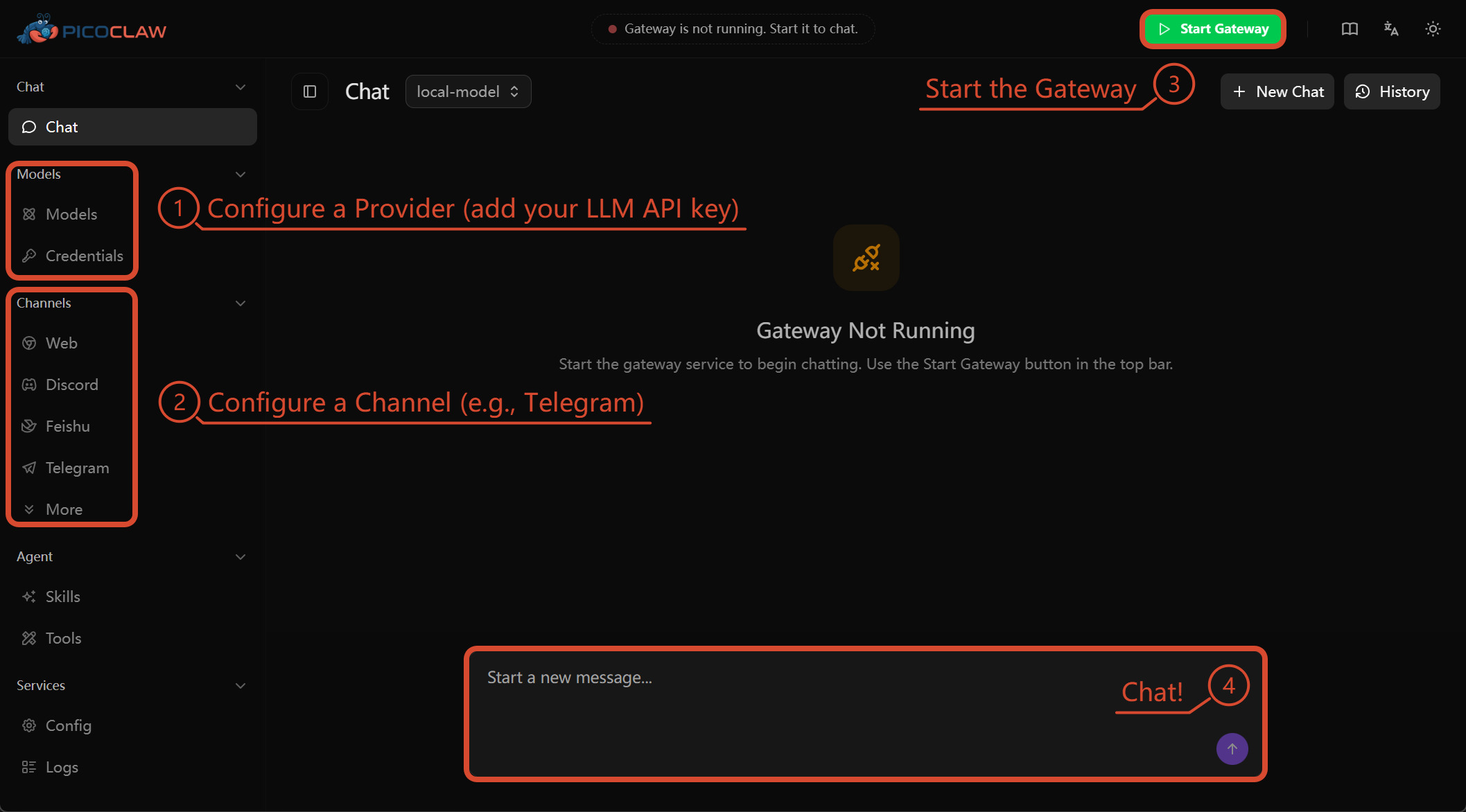
- Access the Web UI — open your domain to manage and interact with PicoClaw
- Connect chat channels — add bot tokens for Telegram, Discord, Slack, etc. in Variables
- Configure MCP servers — extend capabilities with external tool integrations
- Set up cron jobs — automate recurring AI tasks
Environment Variables
| Variable | Description |
|---|---|
OPENAI_API_KEY | OpenAI / Zeabur AI Hub API key |
ANTHROPIC_API_KEY | Anthropic Claude API key |
GEMINI_API_KEY | Google Gemini API key |
TELEGRAM_BOT_TOKEN | Telegram bot token (optional) |
DISCORD_BOT_TOKEN | Discord bot token (optional) |
Important Notes
- PicoClaw is pre-v1.0 (v0.2.4) — suitable for experimentation, not production-critical workloads
- At least one LLM API key must be configured for the agent to function
- The Launcher Web UI is exposed on this domain
License
MIT — GitHub
Services