


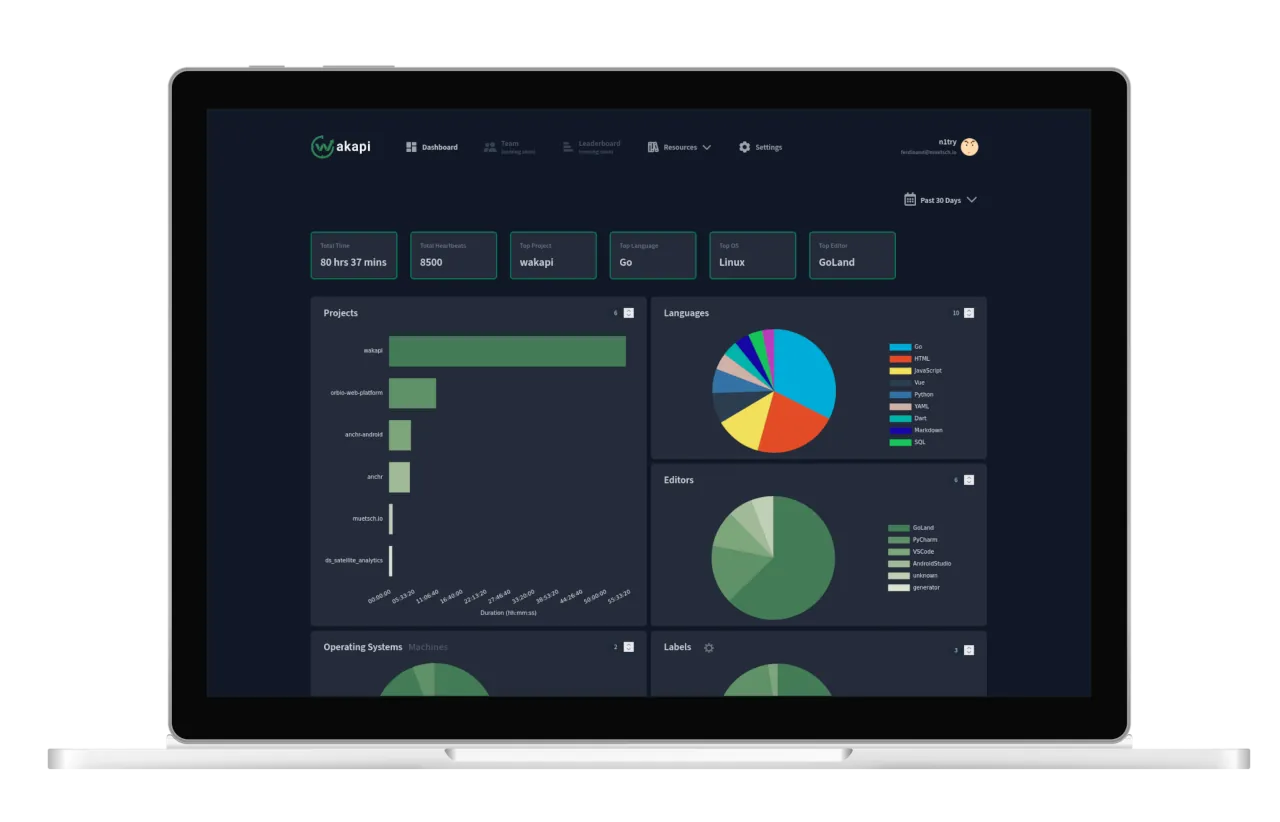
wakapi
📊 A minimalist, self-hosted WakaTime-compatible backend for coding statistics
Services

postgresql
postgres:17A template to deploy muety/wakapi, a minimalist, self-hosted WakaTime-compatible backend for coding statistics.
Configuration
While deploying, you should at least set a domain for your wakapi instance.
Runtime Configuration
You can specify configuration options either via a config file (edit /app/config.yml using config editor in service settings) or via environment variables (edit in variables). Here is an overview of useful options:
| YAML key / Env. variable | Default | Description |
|---|---|---|
env /<br>ENVIRONMENT | dev | Whether to use development- or production settings |
app.leaderboard_enabled /<br>WAKAPI_LEADERBOARD_ENABLED | true | Whether to enable the public leaderboard |
app.leaderboard_scope /<br>WAKAPI_LEADERBOARD_SCOPE | 7_days | Aggregation interval for public leaderboard (see here for allowed values) |
app.leaderboard_generation_time /<br>WAKAPI_LEADERBOARD_GENERATION_TIME | 0 0 6 * * *,0 0 18 * * * | One or multiple times of day at which to re-calculate the leaderboard |
app.leaderboard_require_auth /<br>WAKAPI_LEADERBOARD_REQUIRE_AUTH | false | Restrict leaderboard access to logged in users only |
app.aggregation_time /<br>WAKAPI_AGGREGATION_TIME | 0 15 2 * * * | Time of day at which to periodically run summary generation for all users |
app.report_time_weekly /<br>WAKAPI_REPORT_TIME_WEEKLY | 0 0 18 * * 5 | Week day and time at which to send e-mail reports |
app.data_cleanup_time /<br>WAKAPI_DATA_CLEANUP_TIME | 0 0 6 * * 0 | When to perform data cleanup operations (see app.data_retention_months) |
app.optimize_database_time /<br>WAKAPI_OPTIMIZE_DATABASE_TIME | 0 0 8 1 * * | When to perform database vacuuming (SQLite, Postgres) or table optimization (MySQL) |
app.import_enabled /<br>WAKAPI_IMPORT_ENABLED | true | Whether data imports from WakaTime or other Wakapi instances are permitted |
app.import_batch_size /<br>WAKAPI_IMPORT_BATCH_SIZE | 50 | Size of batches of heartbeats to insert to the database during importing from external services |
app.import_backoff_min /<br>WAKAPI_IMPORT_BACKOFF_MIN | 5 | "Cooldown" period in minutes before user may attempt another data import |
app.import_max_rate /<br>WAKAPI_IMPORT_MAX_RATE | 24 | Minimum number of hours to wait after a successful data import before user may attempt another one |
app.inactive_days /<br>WAKAPI_INACTIVE_DAYS | 7 | Number of days after which to consider a user inactive (only for metrics) |
app.heartbeat_max_age /<br>WAKAPI_HEARTBEAT_MAX_AGE | 4320h | Maximum acceptable age of a heartbeat (see ParseDuration) |
app.warm_caches /<br>WAKAPI_WARM_CACHES | true | Whether to perform some initial cache warming upon startup |
app.custom_languages | - | Map from file endings to language names |
app.avatar_url_template /<br>WAKAPI_AVATAR_URL_TEMPLATE | (see config.default.yml) | URL template for external user avatar images (e.g. from Dicebear or Gravatar) |
app.date_format /<br>WAKAPI_DATE_FORMAT | Mon, 02 Jan 2006 | Go time format strings to format human-readable date (see Time.Format) |
app.datetime_format /<br>WAKAPI_DATETIME_FORMAT | Mon, 02 Jan 2006 15:04 | Go time format strings to format human-readable datetime (see Time.Format) |
app.support_contact /<br>WAKAPI_SUPPORT_CONTACT | hostmaster@wakapi.dev | E-Mail address to display as a support contact on the page |
app.data_retention_months /<br>WAKAPI_DATA_RETENTION_MONTHS | -1 | Maximum retention period in months for user data (heartbeats) (-1 for unlimited) |
app.max_inactive_months /<br>WAKAPI_MAX_INACTIVE_MONTHS | 12 | Maximum number of inactive months after which to delete user accounts without data (-1 for unlimited) |
server.timeout_sec /<br> WAKAPI_TIMEOUT_SEC | 30 | Request timeout in seconds |
server.base_path /<br> WAKAPI_BASE_PATH | / | Web base path (change when running behind a proxy under a sub-path) |
server.public_url /<br> WAKAPI_PUBLIC_URL | http://localhost:3000 | URL at which your Wakapi instance can be found publicly |
security.disable_local_auth /<br> WAKAPI_DISABLE_LOCAL_AUTH | false | Disables login via local credentials (username and password) to enforce OIDC provider login |
security.disable_webauthn /<br> WAKAPI_DISABLE_WEBAUTHN | true | Disables login via WebAuthn (security keys, biometrics, etc.) |
security.password_salt /<br> WAKAPI_PASSWORD_SALT | - | Pepper to use for password hashing |
security.insecure_cookies /<br> WAKAPI_INSECURE_COOKIES | true | Whether or not to allow cookies over HTTP. For production, it is highly recommended to serve Wakapi via HTTPS and set this to false. |
security.cookie_max_age /<br> WAKAPI_COOKIE_MAX_AGE | 172800 | Lifetime of authentication cookies in seconds or 0 to use Session cookies |
security.allow_signup /<br> WAKAPI_ALLOW_SIGNUP | true | Whether to enable local user registration |
security.oidc_allow_signup /<br> WAKAPI_OIDC_ALLOW_SIGNUP | true | Whether to enable user registration via OIDC |
security.signup_captcha /<br> WAKAPI_SIGNUP_CAPTCHA | false | Whether the registration form requires solving a CAPTCHA |
security.invite_codes /<br> WAKAPI_INVITE_CODES | true | Whether to enable registration by invite codes. Primarily useful if registration is disabled (invite-only server). |
security.disable_frontpage /<br> WAKAPI_DISABLE_FRONTPAGE | false | Whether to disable landing page (useful for personal instances) |
security.expose_metrics /<br> WAKAPI_EXPOSE_METRICS | false | Whether to expose Prometheus metrics under /api/metrics |
security.trusted_header_auth /<br> WAKAPI_TRUSTED_HEADER_AUTH | false | Whether to enable trusted header authentication for reverse proxies (see #534). Use with caution! |
security.trusted_header_auth_key /<br> WAKAPI_TRUSTED_HEADER_AUTH_KEY | Remote-User | Header field for trusted header authentication. Caution: proxy must be configured to strip this header from client requests! |
security.trusted_header_auth_allow_signup /<br> WAKAPI_TRUSTED_HEADER_AUTH_ALLOW_SIGNUP | false | Whether to allow creation of new users based on upstream trusted header authentication (see #808) |
security.trust_reverse_proxy_ips /<br> WAKAPI_TRUST_REVERSE_PROXY_IPS | - | Comma-separated list of IPv4 or IPv6 addresses or CIDRs of reverse proxies to trust to handle authentication (e.g. 172.17.0.1, 192.168.0.0/24, [::1]). |
security.signup_max_rate /<br> WAKAPI_SIGNUP_MAX_RATE | 5/1h | Rate limiting config for signup endpoint in format <max_req>/<multiplier><unit>, where unit is one of s, m or h. |
security.login_max_rate /<br> WAKAPI_LOGIN_MAX_RATE | 10/1m | Rate limiting config for login endpoint in format <max_req>/<multiplier><unit>, where unit is one of s, m or h. |
security.password_reset_max_rate /<br> WAKAPI_PASSWORD_RESET_MAX_RATE | 5/1h | Rate limiting config for password reset endpoint in format <max_req>/<multiplier><unit>, where unit is one of s, m or h. |
security.oidc | [] | List of OpenID Connect provider configurations (for details, see wiki) |
security.oidc[0].name /<br> WAKAPI_OIDC_PROVIDERS_0_NAME | - | Name / identifier for the OpenID Connect provider (e.g. gitlab) |
security.oidc[0].display_name /<br> WAKAPI_OIDC_PROVIDERS_0_DISPLAY_NAME | - | Optional "human-readable" display name for the provider presented to the user |
security.oidc[0].client_id /<br> WAKAPI_OIDC_PROVIDERS_0_CLIENT_ID | - | OAuth client name with this provider |
security.oidc[0].client_secret /<br> WAKAPI_OIDC_PROVIDERS_0_CLIENT_SECRET | - | OAuth client secret with this provider |
security.oidc[0].endpoint /<br> WAKAPI_OIDC_PROVIDERS_0_ENDPOINT | - | OpenID Connect provider API entrypoint (for discovery) |
security.oidc[0].username_claim /<br> WAKAPI_OIDC_PROVIDERS_0_USERNAME_CLAIM | - | Optionally spcified custom OIDC ID token claim to read username from (by preferred_username, nickname and sub are checked) |
security.oidc[0].scopes /<br> WAKAPI_OIDC_PROVIDERS_0_SCOPES | - | Additional OAuth scopes to request beyond openid, profile and email (to be used in custom username claim) |
mail.enabled /<br> WAKAPI_MAIL_ENABLED | false | Whether to allow Wakapi to send e-mail (e.g. for password resets) |
mail.sender /<br> WAKAPI_MAIL_SENDER | - | Default sender address for outgoing mails |
mail.skip_verify_mx_record /<br> WAKAPI_MAIL_SKIP_VERIFY_MX_RECORD | false | Whether to skip validating MX DNS record for user email addresses |
mail.provider /<br> WAKAPI_MAIL_PROVIDER | smtp | Implementation to use for sending mails (one of [smtp]) |
mail.smtp.host /<br> WAKAPI_MAIL_SMTP_HOST | - | SMTP server address for sending mail (if using smtp mail provider) |
mail.smtp.port /<br> WAKAPI_MAIL_SMTP_PORT | - | SMTP server port (usually 465) |
mail.smtp.username /<br> WAKAPI_MAIL_SMTP_USER | - | SMTP server authentication username |
mail.smtp.password /<br> WAKAPI_MAIL_SMTP_PASS | - | SMTP server authentication password |
mail.smtp.tls /<br> WAKAPI_MAIL_SMTP_TLS | false | Whether the SMTP server requires TLS encryption (false for STARTTLS or no encryption) |
mail.smtp.skip_verify /<br> WAKAPI_MAIL_SMTP_SKIP_VERIFY | false | Whether to allow invalid or self-signed certificates for TLS-encrypted SMTP |
sentry.dsn /<br> WAKAPI_SENTRY_DSN | – | DSN for to integrate Sentry for error logging and tracing (leave empty to disable) |
sentry.environment /<br> WAKAPI_SENTRY_ENVIRONMENT | (env) | Sentry environment tag (defaults to env / ENV) |
sentry.enable_tracing /<br> WAKAPI_SENTRY_TRACING | false | Whether to enable Sentry request tracing |
sentry.sample_rate /<br> WAKAPI_SENTRY_SAMPLE_RATE | 0.75 | Probability of tracing a request in Sentry |
sentry.sample_rate_heartbeats /<br> WAKAPI_SENTRY_SAMPLE_RATE_HEARTBEATS | 0.1 | Probability of tracing a heartbeat request in Sentry |
refer to Original README for all configuration options.
Setup on Wakatime client
Wakapi relies on the open-source WakaTime client tools. In order to collect statistics for Wakapi, you need to set them up.
- Set up WakaTime for your specific IDE or editor. Please refer to the respective plugin guide
- Edit your local
~/.wakatime.cfgfile as follows.
[settings]
# replace localhost:3000 with Your wakapi server domain
api_url = http://localhost:3000/api

# Your Wakapi API key (get it from the web interface after having created an account)
api_key = 406fe41f-6d69-4183-a4cc-121e0c524c2b
Optionally, you can set up a client-side proxy in addition.
Services